As promised in our previous post, today we will be entering the confusing, challenging, but absolutely fantastic world of soap and mirrors. During the production of our last collaborative project, reflections and water were two key elements that needed to be as realistic as possible. We attempted many methods of achieving these effects; from reflections and water being illustrated on a chalk board, to more abstract worlds of paper boats on lakes of clouds. In the end, a mirror proved to be the most effective tool. Working with mirrors in stop-motion animation is no easy task, however. Between reflected light causing banding in the animation, and managing all the reflections, things can become incredibly complicated. For the set of Make Do, we were working with a 1.1m x 1m mirror, which required some serious innovation to pull off. Let’s take a dive into the restrictions we faced in building our set, and how we solved the mystery of how to rig a backdrop above a mirror that covered all angles in our storyboard.
IKEA BEDS & PAINTED FABRIC
During the initial water tests for Make Do (more on that later), we were working on a much smaller scale, using a top-down table. For anyone who isn’t familiar with top down tables: these are animation desks with multiple layers of glass. Usually, you would place the camera facing down so that you can animate on multiple layers at once. This can be used to create incredibly beautiful and complex scenes. While we experimented with the mirror, we attached the camera to a tripod and shot at an angle, with a painted backdrop on the layer of glass above the mirror. This allowed us to create a beautiful world, especially when we added another sheet of glass between the backdrop and the mirror, and added fish in between. While the fish were beautiful, they wouldn’t be possible in our final set.
Due to the scale of our set, achieving more than one layer in the reflection was not remotely possible. Our storyboard was immensely complicated, with some very dynamic shots that would be difficult to pull off on a reflective surface. In fact, it turned out that the most effective way to cover all of our angles was to create a 4.5m² curve and position it above the set. The curve took many hours to create, and was engineered using an Ikea “Cama Alta,” or bed on stilts. We disassebmbled the bed and created two 90-degree brackets. We then cut stips of MDF wood from the back of an old recycled cupboard, which we attached using the same tiny nails from our previous article to create two matching curves. With the brackets in place we painted our 4.5 m² and attached it to the curve using a staple gun. In order to rig the backdrop above the mirror, we attached our curve to the scaffolding on the ceiling of our studio using zip ties. This was very effective, but it also meant that we could only shoot from one side of the room. We needed to find a way of making our background adjustable so we should shoot different angles without re-orientating our set.
MOVING MOUNTAINS
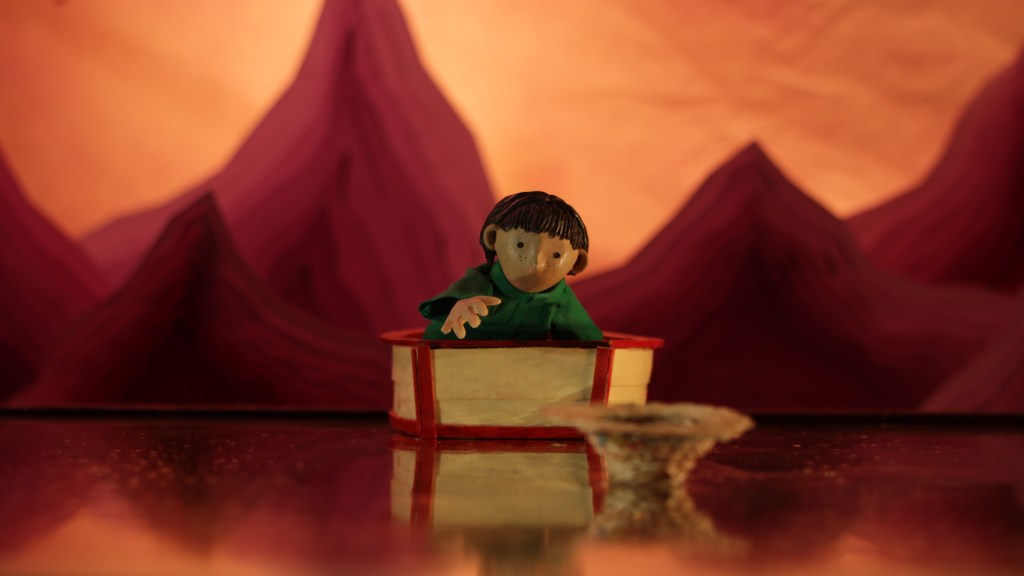
When we first started attempting to figure out our background, we were at a total loss. While refelctions and water were too important visual elements in our story, space was another very important thing to consider. And here, we’re talking about the age old challenge: creating a sense of space on camera when you have limited space in reality. Our mirror already took up most of the studio, leaving us very limited for space. We had initially planned to builid a 3-dimensional mountain range using old newspaper, but this quickly proved to require too much space. After much debate, we elected to stay a few hours together at the end of the day, all bring some random materials, and spend the evening experimenting once more. After a number of trial shots and layouts, we elected for a papercutout approach, using the countours of the mountains to give them some sort of depth and dimension. We proceeded to design 9 mountains in Illustrater, which we laser cut and labled from 1-9. We then drilled holes for all 9 mountains in varying configurations on a recycled cupboard door to make a background table with a North, East, South and West modular mountain system. This way, our character was surrounded by mountain in a very strange and surreal world, which fit well with the narrative of the film.
A LAKE OF SOAP
With our mountains set up and our backdrop erected, our set was almost complete. The final touch was adding the water, which was a truly unique challenge. In the early days of creating our film, we experimented with a number of techniques for animating water in our film. We explored the possibility of adding water in post, but this did not align with our desire to master effects-animation in stop-motion. We tried paper bags, illustration, slime and hair gel, but none created the effect we were hoping for. As a last resort, we swapped the hair gel with shower gel, which worked perfectly! This was all good and well in terms of aesthetic, but it presented the challenge of keeping the soap on top of the mirror. In the end, we used the fame of the mirror, attached with silicone, to create a sort of dam that could be filled with soap. This solved the issue of keeping the soap on the mirror, but created a harsh white line that split the scene from its backdrop. Our solution, to paint the frame a colour that matched the set, was effective, but occasionally resulted in the soap turning pink. Alas, this was a complication we just had to accept and work with.
A trusty conclusion
At the end of the day, despite complications with pink soap, soap on the floor…. a long list of soapy nightmares, we really loved our set. It fully captured the surreal ambience we were hoping for, and allowed us to create a really unique aesthetic. Beyond this, our water animation technique was truly something. It is very difficult to create realistic water in stop-motion without entering the land of CGI. Our liquid soap technique offered a beauiful, fluid final result that we felt was something else. The film may be finished, but this technique is one we will surely use again.
 HOME
HOME 